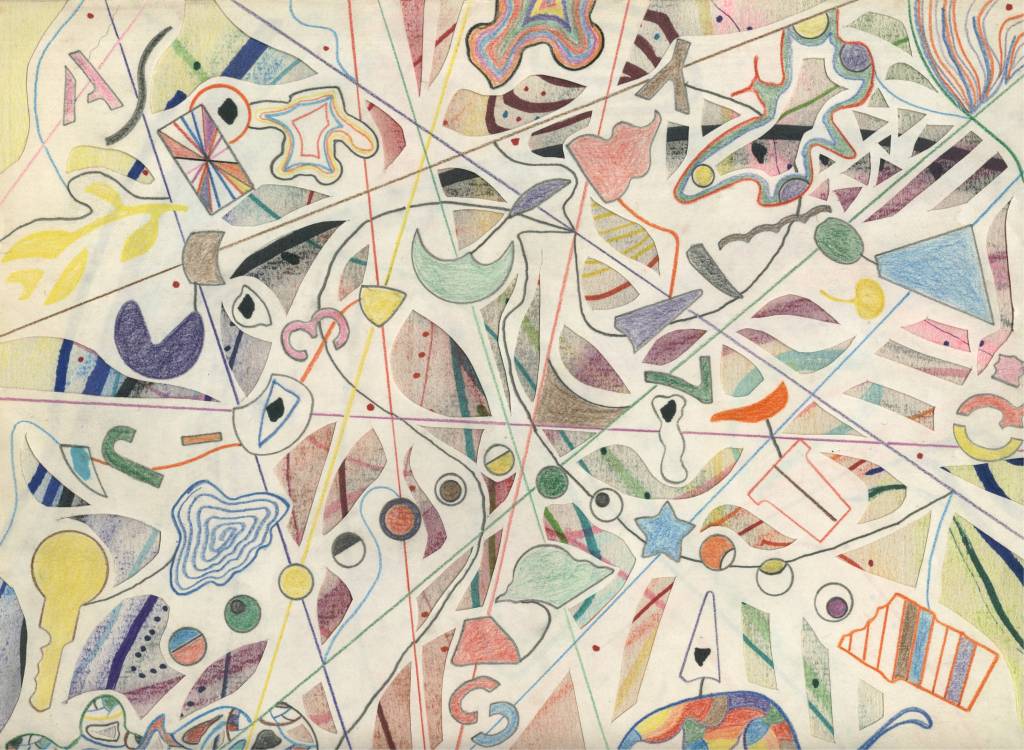
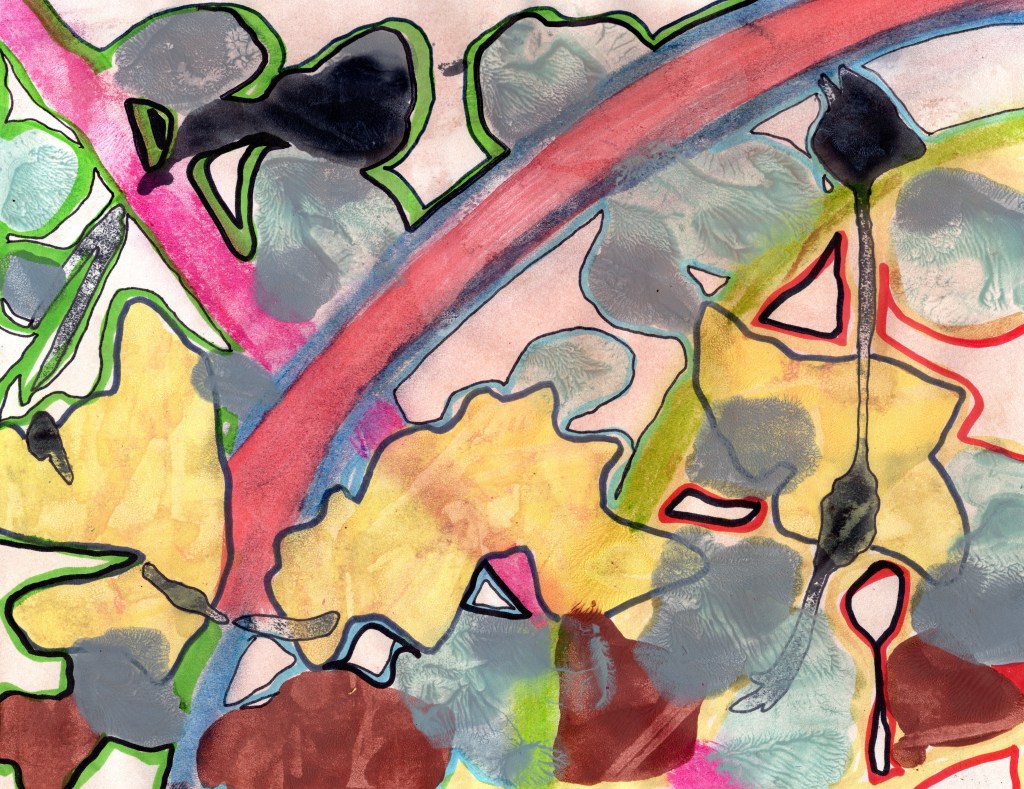
Lorca

Accumulated By David Jacobi

descending to the street

fandangos and improbabilities

turn their backs to silence

Synethesia

Ineffable and intuitively

they break the veil of mystery

giving complete references

for a tragic blunder, a vision of art disembodied

a child, left unadressed

Offers striking illustrations

Of unexpected synergy

Seven voices

Speak

2011 By David Jacobi

This is the first of several upcoming “collage poems” I have written and assembled. Noticing different sentence structures and word rhythms in various books I was reading I simply began writing down what I liked and put together what seemed to me to match and flow. These became my free verse collage poems, with some of my own lines scattered about usually acting as connectors or buffers. With a traditional poem I always begin with a subject in mind while with a collage poem I never do, letting the words gather and arrange to tell their own stories.

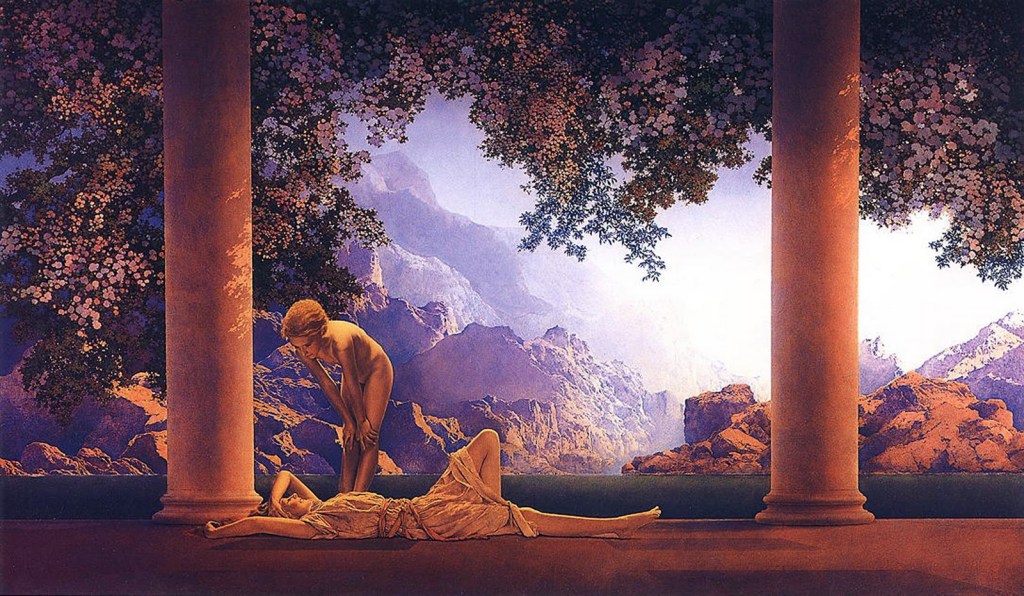
Image of the Month

Daybreak by Maxfield Parrish

Daybreak (1922) by Maxfield Parrish (1870-1966) according to americanillustration.org: “In 1922, Maxfield Parrish produced DAYBREAK, which he referred to as ‘the great painting’. Distributed as an art print through the House of Art, DAYBREAK became the most successful art print of the last century and secured Parrish’s position as the most popular illustrator after the First World War. In composition it resembles a stage set, which is appropriate, since Parrish loved the theater and had designed a number of sets for masques in Cornish, New Hampshire as well as for a New York performance of Shakespeare’s The Tempest. It was laid out according to dynamic symmetry using photographs of Kitty Owen, his daughter Jean and Susan Lewin as models, posed amidst a backdrop of architectural elements, columns, urns, and fantastical landscape. The print was the sensation of the decade and was displayed in one of every four American homes. It is said to be the most reproduced art image in history, surpassing THE LAST SUPPER and Andy Warhol’s soup cans.” That explains why I have seen so many of these prints over the years in flea markets and antique shops.

Bob Dylan

Bob Dylan in 1990

His music first came into my life with the album Bringing It All Back Home, which I acquired during the early 70’s. I already owned several Beatles albums, so Bob really stood no chance. The only folk music I knew was from my Puff The Magic Dragon record and seeing Pete Seeger on TV, and what I heard from Bob really did not interest a young rock and roll boy. As I progressed into 1970’s rock Bob kept popping up here and there. I bought Blonde On Blonde and Desire and was intrigued enough to re-listen to All Back Home. It occurred to me that this was someone I should have been paying more attention to. I listened to more of his albums and became a casual fan. In 1990 I became a devoted one. During the summer of that year I won tickets to see him in concert at the Iowa State Fair Grandstand. The crowd numbered over 10,000 people and the opener was a band called Wire Train. Their spacey guitars echoed across the big open Grandstand, and it seemed like their songs were written to be played outdoors. Then came Bob and his band. I had heard he would play his songs differently in concert, sometimes disappointing his fans. He played them differently that night, but it was no disappointment to this fan. Almost every song he and his band played was hard and fast, and I don’t think I understood hardly any of the lyrics. He didn’t banter with the crowd, just moving from one great song to the next. It turned out to be one of the best concerts I have ever experienced. I continue to listen to his music, have read Chronicles, and keep up with his new releases. But that outdoor concert so many years ago might be the highlight of my appreciation of one of the masters of modern music.

The Worst Problem

Mowing Ditches

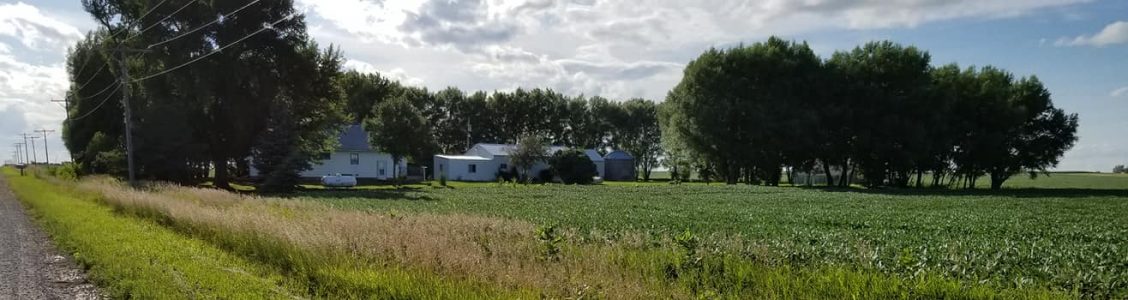
One recent morning Shelly came in from a stroll around the acreage with the dogs to report there was a loud noise coming from the machine shed I should investigate. Stepping into the main room of the shed I was surrounded by a continuous high pitched shrieking alarm. At first I thought it was coming from the ceiling, but as I moved around the shed it seemed to be all around me. Walking back outside I wondered what the noise was and how could I make it stop. Shelly suggested I ask our neighbor who happened to be out mowing the ditches along our road with his tractor. I could see he was coming our way so I walked down the driveway to flag him down. The driver turned out not to be our neighbor but a county worker I had never met before. He stepped out of the cab and introduced himself. I apologized for bothering him, explaining I thought he was the neighbor, but since he was here I figured I might as well ask him if he had ever encountered a mystery noise like what was coming from my machine shed. A little reluctantly he agreed to take a look, and I can only imagine what he was thinking about this strange situation. We walked up the driveway and entered the shed. He stood for just a few seconds, then walked over to the riding mower and turned the key from auxiliary to off. The noise stopped. I had no idea the mower had an alarm. We looked at each other and chuckled, and I admitted that I felt pretty stupid. He said, “Well, if that is the worst problem we have to face today I think we are doing okay.” I thanked him as he walked back down the driveway to his tractor to continue mowing.

Obscure America: George E. Ohr

George E. Ohr

George E. Ohr (1857-1918) was a local potter born in Mississippi who was self described as the “Mad Potter of Biloxi.” He had a shop there and created abstract ceramics from 1880 until 1909. He considered his work ahead of its time, but predicted “When I am gone, my work will be praised, honored, and cherished. It will come.” After a 25 year spell of not selling a single piece he closed up his shop and never threw clay again. The shop sat for decades after his death, holding hundreds of his unusual pieces, and Ohr sank into obscurity. His son ran a gas station on the property and one day in the 1960’s he offered to show a customer some of his fathers pottery. The amazing colors and twisted and pinched shapes of the pottery led to the rediscovery and appreciation of Georges life work. There is now an art museum in Biloxi with a permanent collection of his ceramics, as well as exhibits of his work at art museums across the country. His prophesy of his work being valued after his death came true, leading to his being called “the Picasso of art pottery.”

Stuffed Mushrooms

Stuffed Mushrooms

This appetizer or side dish never lasts long at get togethers with family and friends. These are simple, delicious and quick to prepare.

Ingredients:

8 ounce package of Button Mushrooms

3 ounces of cream cheese

½ pound of cooked Italian sausage

Mix the sausage and cheese. Remove mushroom stems and stuff mushrooms with the mix. (We usually freeze the stems for later use in a soup or stew) Bake in a greased 8 X 8 pan at 350 degrees for 25 minutes.