

Nikola Tesla (1856-1943) sitting among one of his Tesla Coils, which is discharging several million volts and could be heard ten miles away.
Nikola Tesla (1856-1943) sitting among one of his Tesla Coils, which is discharging several million volts and could be heard ten miles away.

Evelyn McHale (1923-1947) jumped from the 86th floor observatory of the Empire State Building, landing on a parked car below. A few minutes later this photo was taken, which has been called “the most beautiful suicide”.
The note she left behind read: “I don’t want anyone in or out of my family to see any part of me. Could you destroy my body by cremation? I beg of you and my family – don’t have any service for me or remembrance for me. My fiance asked me to marry him in June. I don’t think I would make a good wife for anybody. He is much better off without me. Tell my father, I have too many of my mother’s tendencies”.

The artist never revealed the meaning of this painting, leaving it up to the viewer to decipher.

Mildred Douglas Chrisman (1895-1982) “left an East Coast finishing school and went west to join the 101 Ranch Wild West show, beginning a colorful career that included winning the World Champion Girl Bronc Rider title twice and acting in silent movies with Tom Mix. A versatile performer, Mildred was skilled in trick riding, trick shooting and training performing animals. After retiring, Mildred became a nurse and eventually opened her own museum dedicated to her cowgirl life.”

Gloomy, beautiful and mysterious.

Diane Arbus (1923 – 1971)
Child with Toy Hand Grenade in Central Park, N.Y.C. 1962
This classic Arbus photo sums up what 2020 has felt like for many of us.
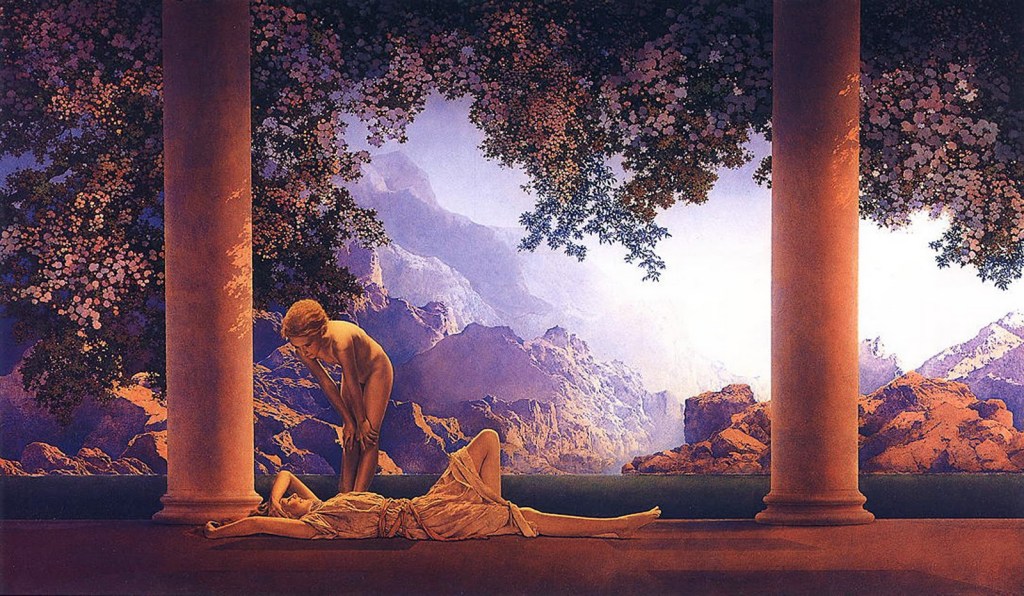
Daybreak (1922) by Maxfield Parrish (1870-1966) according to americanillustration.org: “In 1922, Maxfield Parrish produced DAYBREAK, which he referred to as ‘the great painting’. Distributed as an art print through the House of Art, DAYBREAK became the most successful art print of the last century and secured Parrish’s position as the most popular illustrator after the First World War. In composition it resembles a stage set, which is appropriate, since Parrish loved the theater and had designed a number of sets for masques in Cornish, New Hampshire as well as for a New York performance of Shakespeare’s The Tempest. It was laid out according to dynamic symmetry using photographs of Kitty Owen, his daughter Jean and Susan Lewin as models, posed amidst a backdrop of architectural elements, columns, urns, and fantastical landscape. The print was the sensation of the decade and was displayed in one of every four American homes. It is said to be the most reproduced art image in history, surpassing THE LAST SUPPER and Andy Warhol’s soup cans.” That explains why I have seen so many of these prints over the years in flea markets and antique shops.

Eyes looking off to the distance, jaw firmly locked, a confident poise to one side, this could very well be a portrait of a Civil War general. Except for the, well…

Lee Marvin as Kid Shelleen in Cat Ballou (1965) for which he won the Academy Award for Best Actor. During his acceptance speech for the Oscar he mentioned, “I think, though, that half of this belongs to a horse somewhere out in San Fernando Valley.”

